

For more than a decade, the smartphone industry marched to an identical, predictable drumbeat. Every annual product cycle brought incremental refinements: slightly faster processors, marginally better camera sensors, and fractionally thinner bezels surrounding a rigid glass slab. While these upgrades made devices more capable, the core physical form factor remained entirely unchanged. A phone was a rectangular piece of glass you carried in your pocket, constrained by the physical dimensions of its screen. That era of rigid uniformity is officially over.
The mobile landscape has entered its most disruptive design renaissance since the introduction of capacitive touchscreens. Driven by breakthroughs in material science, flexible organic light-emitting diode panels, and precision mechanical engineering, foldable and rollable displays have graduated from experimental tech prototypes into refined, mainstream powerhouses. Devices that transform from compact pocketsize squares into sprawling tablet canvases are no longer futuristic concepts; they are actively reshaping how we work, consume media, and interact with technology every single day.
The Engineering Breakthroughs Behind the Bend
To appreciate why foldable and rollable screens represent such a monumental leap forward, it helps to understand the extreme physics involved. For years, the greatest barrier to flexible displays was not the screen panel itself, but every component required to support it. Traditional glass shatters when bent, rigid circuit boards snap under continuous stress, and batteries cannot fold without failing or creating safety hazards.
Overcoming these obstacles required a complete reimagining of mobile hardware engineering. Manufacturers turned to ultra-thin flexible glass and advanced polymer layers that can bend thousands of times without fatigue. Beneath these panels, complex multi-axis hinge mechanisms distribute mechanical stress evenly, preventing creases from deepening over time while protecting internal components from dust and moisture ingress.
Equally vital are the software innovations accompanying these hardware changes. Operating systems had to evolve to become fluid and responsive, dynamically scaling user interfaces, multi-window layouts, and aspect ratios the moment a device transitions from a closed pocket profile to an expanded workspace. The result is a seamless hardware-software harmony that makes the act of opening a phone feel entirely natural.
Form Factor Diversity: Flippers Versus Book-Style Folds
The current marketplace showcases two distinct architectural approaches to folding technology, each catering to entirely different user priorities and daily workflows.
The Compact Appeal of Flip Formats
Vertical flip-style foldables appeal directly to users who prioritize pocketability and effortless portability. By folding a conventional smartphone screen in half, these devices shrink down into a neat, compact square that slips easily into small pockets or structured bags without bulging.
Beyond portability, the vertical fold introduces creative utility through its physical geometry. When partially folded, the device acts as its own built-in tripod, transforming video calls, timed group photos, and content recording into effortless, hands-free experiences. Furthermore, sophisticated cover screens have evolved from simple notification tickers into fully functional miniature displays, allowing users to reply to messages, check transit directions, and snap high-resolution selfies without ever opening the main screen.
The Productivity Powerhouse of Book-Style Folds
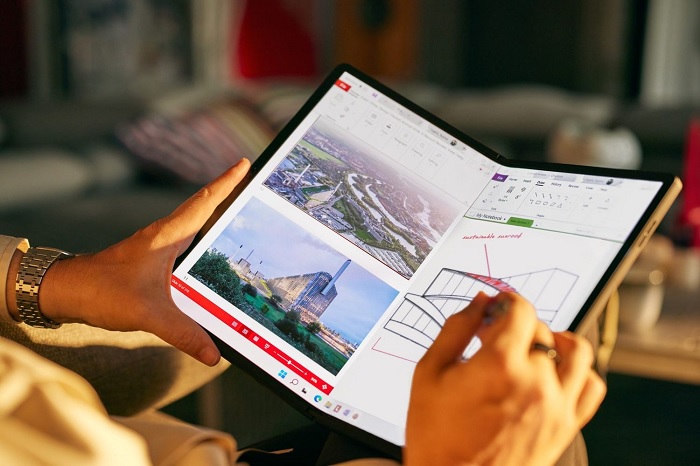
Horizontal book-style foldables, by contrast, target power users, mobile professionals, and media enthusiasts who crave maximum digital real estate. When closed, these devices function as standard smartphones for quick text replies and single-handed navigation. When opened, however, they expand to reveal a sweeping, tablet-sized canvas.
This expansive workspace changes how users interact with complex mobile applications. Running two productivity apps side-by-side, reviewing financial spreadsheets, editing high-resolution photographs, or reading digital documents becomes remarkably comfortable on an uninhibited inner display. For travelers and remote workers, carrying a single device that bridges the gap between a pocket phone and a digital workspace eliminates the need to pack a separate tablet.
The Horizon of Innovation: Entering the Rollable Era
Even as foldable devices achieve mainstream refinement and commercial success, research laboratories and engineers are already pushing past the hinge. The next major frontier in mobile display technology belongs to rollable and expandable form factors.
While foldables rely on a fixed crease and mechanical folding mechanisms, rollable displays utilize motorized or manual tracks that allow the screen itself to physically extend and retract from a compact housing. Imagine pulling gently on the side of a standard smartphone to watch the display smoothly unfurl into a wide-aspect media screen or a square digital notepad, all without a visible crease or a bulky hinge mechanism.
This approach solves one of the persistent trade-offs of current foldables: thickness and weight. Rollable concepts promise to deliver the best of both worlds—maintaining the ultra-slim profile of a traditional slab phone during normal daily use while offering expandable screen estate on demand. Although manufacturing yields and mechanical durability present ongoing engineering challenges, rollable technology represents the ultimate evolution of adaptable screen design.
Redefining the Future of Human-Computer Interaction
The shift toward flexible, foldable, and rollable displays transcends mere hardware novelty. It represents a fundamental philosophy change in how we think about personal computing devices. For decades, humans adapted their habits to fit the rigid physical dimensions of screens. Flexible display technology reverses that dynamic, allowing technology to adapt dynamically to whatever task is at hand.
As materials become even more resilient, battery technologies grow more flexible, and software ecosystems mature, the boundary between phones, tablets, and computers will continue to blur. We are witnessing the dawn of an era where your screen size is no longer dictated by the pocket in your trousers, but by your immediate functional needs. For mobile enthusiasts and everyday users alike, this exciting new frontier proves that the most innovative chapter of smartphone history has only just begun.
