
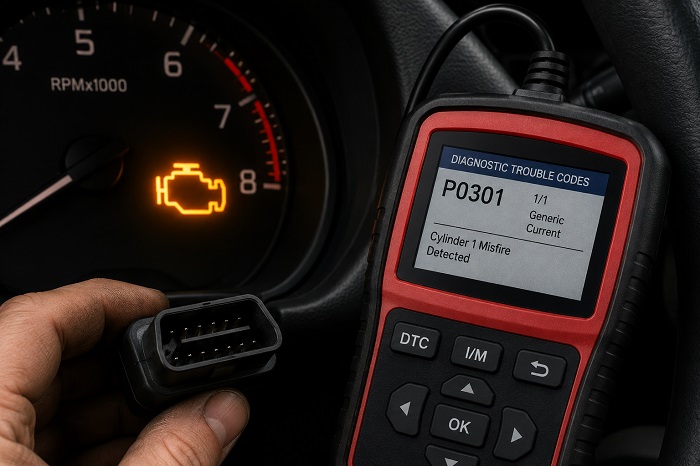

Driving down the highway, listening to your favorite podcast or an album you have heard a hundred times, everything feels routine. Your car hums smoothly beneath you, the morning commute is flowing, and then, without warning, a small amber icon on your dashboard begins to blink. For many drivers, the immediate reaction is a mix of annoyance and denial. We bargain with ourselves. We wonder if it is just a loose gas cap, or if we can make it to our destination twenty miles down the road before dealing with it. After all, the car still feels like it is running.
There is a profound, costly difference between a check engine light that remains steadily illuminated and one that flashes. While a solid light usually points to an emissions hiccup or a minor sensor fault that warrants attention at your next convenience, a flashing check engine light is your vehicle screaming in real time. It signals active, severe engine misfires that are dumping unburned fuel straight into the exhaust system. Ignoring that blink and continuing to drive even for a few minutes can transform a simple sensor fix into a catastrophic, four-figure engine failure. Knowing what happens under the hood during this event explains why pulling over safely and immediately is the single most important decision you can make.
Understanding the Anatomy of a Dashboard Warning
To appreciate why a flashing light requires an emergency response, it helps to understand how your car’s onboard computer communicates trouble. Modern vehicles rely on an intricate network of sensors monitoring everything from crankshaft rotation speed to oxygen levels in the exhaust manifold. The powertrain control module acts as the brain of this operation, constantly adjusting fuel delivery and ignition timing to keep the engine running efficiently.
When a sensor detects that a cylinder is failing to ignite the air-fuel mixture properly, it records a misfire code. If that misfire is intermittent or minor, the computer turns on a solid check engine light, logging the fault so a technician can diagnose it later. However, when the misfire rate crosses a threshold that threatens to destroy expensive emissions equipment—most notably the catalytic converter—the computer changes its strategy. It flashes the light on and off rapidly to grab your attention. It is an automated emergency flare designed to tell you that engine damage is actively occurring right now.
What Happens Under the Hood During a Severe Misfire
When a cylinder misfires, the spark plug fails to ignite the compressed mixture of gasoline and air inside that specific combustion chamber. That unburned fuel does not simply vanish. Instead, as the exhaust valve opens, the raw mixture is pushed out of the cylinder and into the exhaust pipe, where temperatures are blistering hot.
The moment that unburned fuel hits the red-hot catalytic converter, it ignites inside the exhaust system. Catalytic converters are designed to handle hot exhaust gases, but they are not built to withstand miniature explosions of raw gasoline. Temperatures inside the converter skyrocket within seconds, often exceeding normal operating limits by hundreds of degrees.
At these extreme temperatures, the precious metals inside the converter begin to melt, ceramic honeycombs fracture, and the component effectively destroys itself. A replacement catalytic converter can easily cost thousands of dollars, making a few extra miles of driving vastly more expensive than a tow truck ride. Beyond the exhaust system, raw fuel washing over the cylinder walls can strip away essential engine oil lubrication, leading to scored pistons, worn piston rings, and complete mechanical failure.
The Immediate Protocol: How to Pull Over Safely
When that amber light starts blinking, adrenaline often spikes. The natural instinct is to slam on the brakes right in the middle of traffic, but panic creates secondary dangers that can be just as hazardous as engine damage. Executing a safe stop requires a calm, methodical sequence of actions.
First, check your rearview and side mirrors while signaling your intention to move. Ease off the accelerator gently; do not stomp on the brakes unless traffic conditions demand it. Smoothly guide your car across lanes toward the right shoulder, an exit ramp, or a quiet side street.
Once you have brought the vehicle to a complete stop, shift into park or neutral and engage your emergency parking brake. Turn on your hazard warning lights immediately to alert trailing motorists. Do not attempt to pop the hood right away while the engine bay is running at critical temperatures. Give the car a few minutes to idle down and cool off before turning the ignition completely off.
Assessing the Situation on the Shoulder
With the engine off, you have bought yourself time to evaluate the situation safely. Listen to the car. Does it sound like it is shaking violently, sputtering, or idling unevenly? Do you smell sulfur or a distinct burning odor? These sensory clues confirm that a severe mechanical issue is present.
At this stage, resist the temptation to restart the car and test your luck. A flashing light does not reset itself by turning the engine off and on again. If the underlying cause is a failing ignition coil, a completely dead spark plug, a massive vacuum leak, or a failing fuel injector, restarting the engine will immediately resume the destructive misfire cycle. Your safest course of action is to call a roadside assistance service or a local towing company.
Common Culprits Behind the Blink
While waiting for a tow truck, your mind naturally wanders to what might have gone wrong. Severe misfires that trigger a flashing light usually stem from a few predictable components within the ignition and fuel delivery systems.
Ignition coils are among the most frequent offenders. As coils age and endure constant heat cycling, their internal insulation breaks down, causing them to fail under load. When a coil pack dies entirely, the spark plug attached to it receives no voltage, resulting in an immediate and dead cylinder misfire.
Worn spark plugs with excessively wide gaps can also fail to ignite the air-fuel mixture, especially under acceleration when cylinder pressures are highest. Fuel delivery problems, such as a clogged or stuck-open fuel injector, can flood a cylinder with too much gas for the spark to handle. Less commonly, internal mechanical issues such as a skipped timing chain, a burnt exhaust valve, or a blown head gasket can cause a drop in compression that prevents proper combustion entirely.
The False Economy of Rolling the Dice
Many drivers hesitate to call a tow truck because of the immediate expense and inconvenience. Paying for a tow and an emergency diagnostic fee feels disruptive, leading people to gamble with their engines. They reason that if the car can still limp along at low speeds, it must be sturdy enough to make it home.
This gamble almost always backfires. What could have been a simple diagnostic check and a hundred-dollar spark plug replacement turns into a severe financial burden when the catalytic converter melts down or internal engine components seize from lack of lubrication. The cost of a tow truck is negligible compared to the price of a rebuilt engine or a new exhaust assembly.
Treating your vehicle with respect when it signals distress ensures it will remain reliable for years to come. Modern cars are marvels of engineering, but they are also complex systems that require intervention when their safety thresholds are breached. The next time that amber icon begins to blink on your dashboard, remember what is happening beneath your feet. Pull over, secure your vehicle, and let the professionals handle the rest. Your engine—and your bank account—will thank you.
